Flyer or Booklet? How to Choose the Right Format for Your Next Project
You have an event to promote, a service to explain or a programme to put in someone’s hands. Do you need a flyer, a booklet—or both?
Start with what the reader needs to do. A flyer gives someone a quick way into your message. A booklet gives them room to explore it. Choosing well is less about looking impressive and more about making the information easy to use.
What job does each format do?
| If you need to… | Start with… | Why |
|---|---|---|
| Invite people to one event | A flyer | The event, date, location and registration route can be understood together. |
| Explain one offer or introduce your services briefly | A flyer | A short introduction helps someone decide whether to take the next step. |
| Guide attendees through an event | A booklet | A schedule, welcome, speaker details and acknowledgements need an organised sequence. |
| Present a catalogue or detailed service guide | A booklet | Sections give readers space to compare and revisit information. |
| Attract interest first, then explain more | Both, with different jobs | The flyer introduces the opportunity; the booklet supports the next conversation. |
Choose a flyer when one message should stand out
Imagine someone picking up your flyer while leaving a meeting. They should be able to find what you offer, why it matters to them and how to respond without searching through paragraphs.
For an event, that usually means a clear event name, the essential details and one registration or contact route. For a business, it could mean a short introduction to your services and an invitation to ask about a project.
Give the page a clear order
Write the main message first. Add the details someone needs to act. Then decide what can move to your website or a later conversation. Your organisation’s full history rarely needs the same space as the event date.
If the design only works after the type has been made tiny, revisit the content before approving it. You may need a shorter message, a different format or a separate piece for the extra details.
For a practical starting point, use our event flyer planning guide. When you have a brief ready, you can also explore our flyer printing options.
Choose a booklet when the reader needs a path through the details
A booklet earns its extra pages when each section helps the reader. Think of an event programme someone checks throughout the day, a service guide used during a meeting, or a publication people take home to read.
Plan the sections before the page count
List what belongs in the booklet, then arrange it in the order a new reader would need it. For an event programme, that might be a welcome, the schedule, participant information and acknowledgements. A service guide might move from who you help to the available services and how to get started.
Give each section a purpose. Repeating the same introduction across several pages does not make a booklet more helpful. Clear headings, useful images and space around the text make it easier to find information.
Once the content is organised, discuss size, page count, paper and binding with your printer. These choices work together; avoid promising a final specification before checking that it suits the project.
A look at our own flyer and booklet
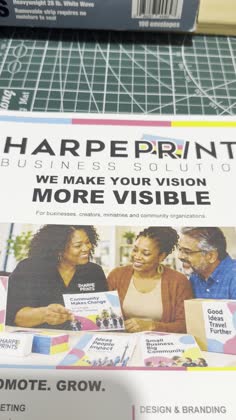
Our Sharpe Prints flyer puts “We make your vision more visible” near the top, introduces our service areas and gives readers a way to contact us. It is an introduction: someone can understand the range of support available without reading a full catalogue.
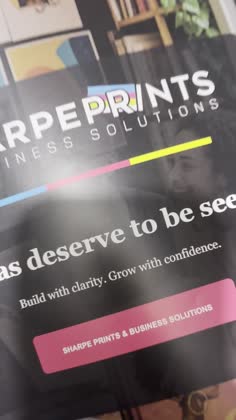
Our booklet takes a different approach, with a cover that introduces the brand and interior pages for more detail. Separating the information into sections gives readers a way through it. The lesson for your project: decide what belongs together, then choose a format that supports that order.
Three questions to answer before ordering
- Where will someone receive it? A handout at a busy event needs a different reading experience from a guide used during a consultation.
- What must they understand now? Separate essential information from details that can wait. Keep anything needed to act—such as dates, location or eligibility—easy to find.
- What should happen next? Choose a clear action: register, enquire, book a conversation or visit a relevant page. Check that the route works.
You do not have to order both formats. Choose the smallest useful piece for the job, then add another when there is a clear reason for it.
What if you need help with the design?
You can start with your information and ideas. Gather your logo, wording, contact details and any images you are authorised to use. Explain who will read the piece and what you want them to do.
Here is a short brief you can copy:
We are creating a print piece for __________. The reader needs to understand __________. Their next step should be __________. It will be handed out or used at __________. We need help with __________. Our required date is __________.
Before approving the final proof, check names, dates, contact details, spelling and links. If there is a QR code, test it with a phone. Nominate one person to gather corrections so that the final version reflects everyone’s agreed changes.
Make your next piece feel like your business
Whether you choose a flyer or booklet, use a consistent business name, logo, colours and contact information. Someone moving from your print piece to your website should recognise the same business.
Our free Small Business Branding Checklist gives you a practical place to start.
Get the free branding checklist
Download after registration. Newsletter tips and offers are a separate, optional choice.
Already planning a project? Tell us what you are creating, including whether you need design help. We can discuss a suitable format and the next steps with you.
Does your business look like one business, everywhere?
Use our free Small Business Branding Checklist to spot what is working and choose what to improve next. No finished design or purchase required.
Get my free branding checklistDownload after registration. Newsletter tips and offers are a separate, optional choice.
Keep building your confidence
A busy week isn’t always a week that moves your business forward
Make room for marketing in a busy business week with five practical decisions and a one-page planning exercise.
Read the guideWhat to Put on an Event Flyer: A Simple Planning Guide
Plan a clear event flyer with the right headline, date, location, admission details and next step. Includes a copy-and-fill brief for your designer.
Read the guide